

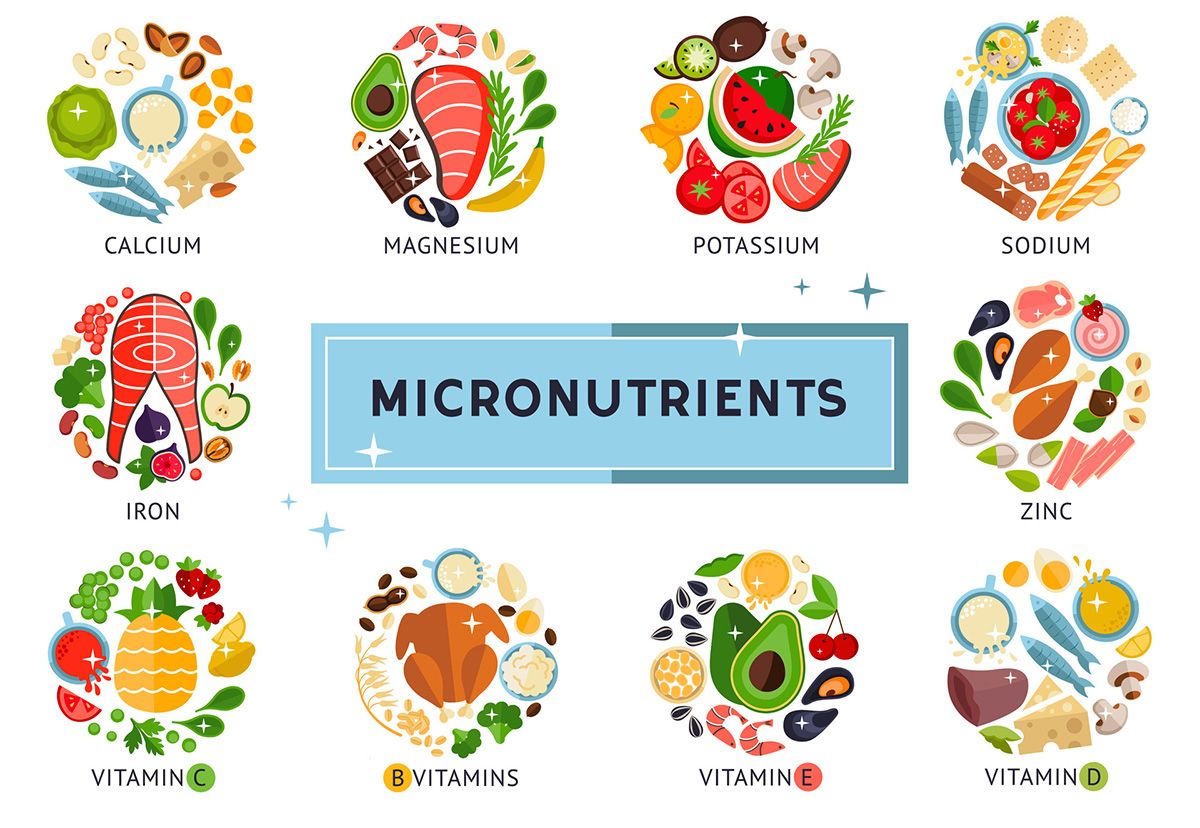
Micronutrients are essential nutrients required by the body in small amounts for various physiological functions. They primarily include vitamins and minerals, which play critical roles in maintaining health, supporting growth, and preventing diseases. In this chapter, we provide a comprehensive overview of micronutrients, their types, functions, sources, and health implications.
Micronutrients are nutrients that the body needs in smaller quantities compared to macronutrients. They are crucial for a wide range of bodily functions, including metabolism, immune function, and bone health.
Vitamins: Organic compounds that are essential for various biochemical processes. There are 13 essential vitamins. This means that these vitamins are required for the body to work properly. They are categorized into two main groups: Water-soluble vitamins and fat-soluble vitamins. Water-soluble vitamins dissolve in water and are not stored in the body. They need to be consumed regularly. They are vitamin C and B-complex vitamins (B1, B2, B3, B6, B7, B9, B12). Fat-soluble vitamins dissolve in fats and can be stored in the body’s fatty tissues. These include vitamins A, D, E, and K.
Minerals: Inorganic elements that are essential for various bodily functions. They can be divided into two categories:
Macrominerals: Required in larger amounts (e.g., calcium, potassium, magnesium).
Microminerals (or trace minerals): Needed in smaller amounts (e.g., iron, zinc, copper, iodine).
Vitamins
Water-soluble vitamins:
As mentioned above, water-soluble vitamins are those that dissolve in water and are not stored in the body in significant amounts. This means they need to be consumed regularly to maintain adequate levels. When excess amounts are ingested, they are typically excreted through urine. They are absorbed directly into the bloodstream from the gastrointestinal tract. Let’s dig a bit deeper and learn where they can be found and what their functions are.
Vitamin C (Ascorbic Acid): Acts as an antioxidant, supports immune function, aids in collagen synthesis, and enhances iron absorption.
Sources: Citrus fruits (oranges, lemons), strawberries, kiwi, bell peppers, broccoli, tomatoes and many other fruits and vegetables.
B Vitamins: The B-complex group consists of eight distinct vitamins:
Vitamin B1 (Thiamine): Important for energy metabolism and nerve function.
Sources: Whole grains, legumes, nuts, and seeds.
Vitamin B2 (Riboflavin): Involved in energy production and cellular function.
Sources: Dairy products, eggs, green leafy vegetables, and fortified cereals.
Vitamin B3 (Niacin): Supports metabolism and DNA repair; can be synthesized from tryptophan.
Sources: Meat, fish, poultry, whole grains, and legumes.
Vitamin B5 (Pantothenic Acid): Essential for synthesizing coenzyme A and fatty acid metabolism.
Sources: Chicken, beef, potatoes, oats, and whole grains.
Vitamin B6 (Pyridoxine): Involved in amino acid metabolism and neurotransmitter synthesis.
Sources: Fish, beef liver, potatoes, and non-citrus fruits.
Vitamin B7 (Biotin): Plays a role in carbohydrate and fat metabolism.
Sources: Eggs (especially yolks), nuts, seeds, and certain vegetables.
Vitamin B9 (Folate or Folic Acid): Crucial for DNA synthesis and cell division; important during pregnancy for fetal development.
Sources: Leafy greens, legumes, seeds, and fortified cereals.
Vitamin B12 (Cobalamin): Necessary for red blood cell formation and neurological function.
Sources: Animal products such as meat, fish, poultry, eggs, and dairy; fortified plant-based alternatives for vegans.
Fat-soluble vitamins:
Fat-soluble vitamins are essential nutrients that dissolve in fats and can be stored in the body’s liver and fatty tissues. There are four fat-soluble vitamins: A, D, E, and K. They are best absorbed when consumed with dietary fats. Unlike water-soluble vitamins, they can be stored in the body for longer periods. These fat-soluble vitamins work synergistically in the body, often complementing each other’s functions to maintain overall health and well-being. Their ability to be stored in the body allows for some reserve, but also necessitates careful consideration of intake, particularly from supplements, to avoid potential toxicity.
Vitamin A: Vitamin A is essential for vision, especially night vision. It supports immune function, promotes cell growth and differentiation, and maintains healthy skin and mucous membranes.
Sources: Liver, kidney, eggs, dairy products, orange and yellow fruits/vegetables, dark green leafy vegetables.
Vitamin D: Primarily promotes calcium absorption, crucial for bone health. It also supports immune function, aids in cell growth, and contributes to muscle function.
Sources: Synthesized in the skin when exposed to sunlight. Food sources: Fatty fish, egg yolks, fortified milk or cereals.
Vitamin E: Acts as a powerful antioxidant, protecting cells from damage caused by free radicals. It supports immune function and helps maintain healthy blood vessels.
Sources: Vegetable oils, nuts and seeds, wheat germ, green leafy vegetables.
Vitamin K: Essential for blood clotting. It also supports bone health by aiding in calcium binding and regulating bone formation.
Sources: Green leafy vegetables, vegetable oils, some fruits, meat, eggs, and dairy products.
Minerals
Minerals are essential nutrients that play crucial roles in various bodily functions. They are categorized into two main groups: macrominerals and microminerals (also called trace minerals). Minerals are vital for numerous physiological processes, including enzyme function, bone formation, fluid balance, and immune system support. Macrominerals are required in larger quantities (over 100 mg/day), while microminerals are required in smaller quantities (under 100 mg/day). Their bioavailability depends on their chemical form and interactions with other nutrients. A well balanced diet typically provides sufficient minerals for most people. However, certain factors like age, pregnancy, specific health condition or even frequent or intense exercise may influence mineral requirements. Let’s dive deeper and learn about functions of each particular mineral along with their sources from diet.
Macrominerals:
Calcium (Ca): Essential for bone and tooth formation, muscle contraction, nerve function, and blood clotting.
Sources: Dairy products, leafy green vegetables, fortified foods.
Phosphorus (P): Aids in bone and teeth formation, energy release, and acid-base balance.
Sources: Meat, fish, poultry, eggs, milk, cereal products.
Magnesium (Mg): Necessary for muscle contraction, nerve function, enzyme activation, and energy metabolism.
Sources: Nuts, beans, whole grains, leafy greens.
Sodium (Na): Regulates fluid balance and blood pressure, crucial for nerve and muscle function.
Sources: Salt, processed foods, naturally present in many foods.
Potassium (K): Essential for fluid balance, muscle contraction, and nerve transmission.
Sources: Bananas, oranges, potatoes, spinach, beans.
Chloride (Cl): Helps maintain fluid balance and forms digestive juices.
Sources: Salt, tomatoes, olives, celery.
Sulfur (S): Part of amino acids and involved in protein synthesis.
Sources: Garlic, onions, broccoli, animal proteins.
Microminerals:
Iron (Fe): Essential for oxygen transport in blood and muscle cells.
Sources: Liver, meats, egg yolks, whole grains, legumes.
Zinc (Zn): Important for immune function, wound healing, and enzyme systems.
Sources: Meat, seafood, whole grains.
Copper (Cu): Required for connective tissue formation and nervous system function.
Sources: Beans, grains, nuts, seeds, organ meats.
Iodine (I): Essential for thyroid hormone production.
Sources: Seafood, iodized salt, egg yolks.
Selenium (Se): Acts as an antioxidant and supports thyroid function.
Sources: Grains, meat, poultry, fish, dairy products, brazil nut(very high concentration of Se).
Manganese (Mn): Assists in carbohydrate, amino acid, and cholesterol metabolism.
Sources: Whole grains, nuts, leafy vegetables.
Fluoride (F): Strengthens bones and teeth, helps prevent dental cavities.
Sources: Fluoridated drinking water, fish, tea.
Chromium (Cr): Helps regulate blood glucose levels and insulin function.
Sources: Liver, brewer’s yeast, whole grains, nuts, cheeses.
Molybdenum (Mo): Acts as a cofactor for several enzymes.
Sources: Legumes, grains, leafy greens, milk, liver.
Micronutrient deficiencies in Vietnam
It should be very clear by now that every single vitamin, mineral or any other nutrient is very important for proper functioning of human body as a whole. Unfortunately, due to poor diet choices in the modern society, we often face various vitamin or mineral deficiencies. These deficiencies remain a significant public health concern in Vietnam, affecting various demographics across the country. Recent studies have shed light on the prevalence of these deficiencies, highlighting the need for targeted interventions. Vitamin D deficiency is notable, with a study in northern Vietnam revealing that 30% of women and 16% of men are affected. Urban residency and age under 30 are significant predictors for women, while the winter season is a key factor for men. This deficiency can lead to weakened bones and increased risk of fractures.
Vitamin A deficiency is particularly concerning among children and nursing mothers. Approximately 13% of children under five suffer from preclinical vitamin A deficiency, while 34.8% of nursing women have low vitamin A levels in their milk. This deficiency can lead to impaired vision and weakened immune function.
Zinc deficiency is widespread, affecting 58% of children under five. The prevalence is even higher in mountainous (80.8%) and rural areas (71.6%). Additionally, 63% of pregnant women and 44.3% of women of childbearing age are zinc deficient, which can impact fetal development and immune function.
Iron deficiency and anemia are also prevalent, with 28.8% of non-pregnant women, 36.5% of pregnant women, and 29.2% of children under 5 affected. These conditions can lead to fatigue, weakness, and developmental issues in children. Other notable deficiencies include vitamin B12, affecting about 12% of women of reproductive age, and iodine deficiency, though specific data for the latter is not provided.
These deficiencies vary by region, with higher prevalence often observed in mountainous and rural areas compared to urban centers. The data underscores the importance of continued efforts to address micronutrient deficiencies in Vietnam, particularly focusing on vulnerable groups such as women of reproductive age and young children. It is therefore crucial to deal with these problems as soon as possible, perhaps starting with proper nutrition education. By tackling these issues, Vietnam can significantly improve public health outcomes and support the optimal growth and development of its population. Although these numbers come from various different studies and surveys, done on variety of participants, it is very likely that the percentages shown above can apply to the vast majority of the country’s population.
Micronutrient intake recommendation
You may be wondering why we didn’t include recommended daily intakes for every vitamin and mineral. The simple reason is that there are too many numbers, and most are meaningless in real life. Nobody walks around knowing what 400 mg of magnesium or 700 µg of vitamin A looks like on a plate.
Instead of obsessing over numerical targets, the far more practical approach is focusing on diet quality. You probably noticed that many vitamins and minerals come from the same types of foods. A balanced diet built primarily on whole, plant-based foods with the addition of high-quality animal products already covers the vast majority of micronutrient needs for most people.
And this connects directly to our previous deep-dive on macronutrients. That article was much more extensive for a reason: if you master the “big three” (protein, carbs, fats) and build your meals from real, nutrient-dense foods, you’ll end up covering the vast majority, if not all of your micronutrient needs automatically. Micros ride on the back of solid macros.
That said, there are cases where supplementation is helpful, or even necessary – depending on health status, diet pattern, lifestyle, and lab markers. We’ll address those scenarios in a separate article.
SOURCES
https://www.ncbi.nlm.nih.gov/books/NBK538510/
https://www.healthline.com/nutrition/water-soluble-vitamins
https://medlineplus.gov/ency/article/002399.htm
https://www.webmd.com/vitamins-and-supplements/fat-soluble-vitamins-vs-water-soluble-vitamins
https://pmc.ncbi.nlm.nih.gov/articles/PMC3328495/
https://pubmed.ncbi.nlm.nih.gov/22878155/
https://www.thelancet.com/journals/lanwpc/article/PIIS2666-6065(24)00158-5/fulltext
https://www.jstage.jst.go.jp/article/jnsv/62/1/62_1/_pdf
https://apjcn.qdu.edu.cn/16_1_11.pdf
https://study.com/learn/lesson/macrominerals-function-sources-food-contain-minerals.html
https://extension.okstate.edu/fact-sheets/minerals-and-the-body.html
https://pmc.ncbi.nlm.nih.gov/articles/PMC8840645/
https://www.canr.msu.edu/news/trending-essential-minerals
https://www.healthline.com/nutrition/micronutrients