

The complete science
1. Why Fueling Matters
During endurance training and racing, your body relies heavily on carbohydrate to produce energy. Most of this comes from glycogen, which is stored in your muscles and liver. Glycogen is the fastest and most efficient fuel for moderate to high-intensity work. But there’s a limit to how much you can store, and you cannot access all of it during hard efforts.
What actually happens inside your body
You start exercising
Your muscles burn glycogen first because it produces energy quickly and supports higher power output.Intensity increases
The higher the effort, the more the body shifts toward carbohydrate, since fat can’t keep up with the energy demand.Liver glycogen starts to drop
The liver only stores about 80–120 g of glycogen. When this drops, blood glucose falls, which affects your brain and coordination.Muscle glycogen becomes less available
You may have several hundred grams of glycogen stored, but it’s split across many muscle fibers, and not all of it is usable during a specific activity.You slow down even if you’re “not empty”
As glycogen drops, your body protects a reserve. Your brain forces you to reduce pace long before you reach zero. This is the classic “bonk.”
The practical takeaway
You do have several hundred grams of glycogen stored.
But you can’t access all of it.
Liver glycogen drops quickly.
Hard efforts drain stores far faster than you think.
Heat and dehydration increase carbohydrate use.
Without carbs during training, performance decline begins within roughly 2–3 hours for most athletes, sooner at higher intensities.
Why fueling during training matters
Proper fueling helps you:
Maintain pace and power output
Keep your brain alert and avoid dips in coordination
Reduce deep fatigue and unnecessary stress on the body
Improve recovery by finishing sessions with better glycogen levels
Train your gut to handle intake on race day
Even if you’re not racing, underfueling makes training less productive and increases cumulative fatigue.
2. How Much Carbs You actually Need
The short answer
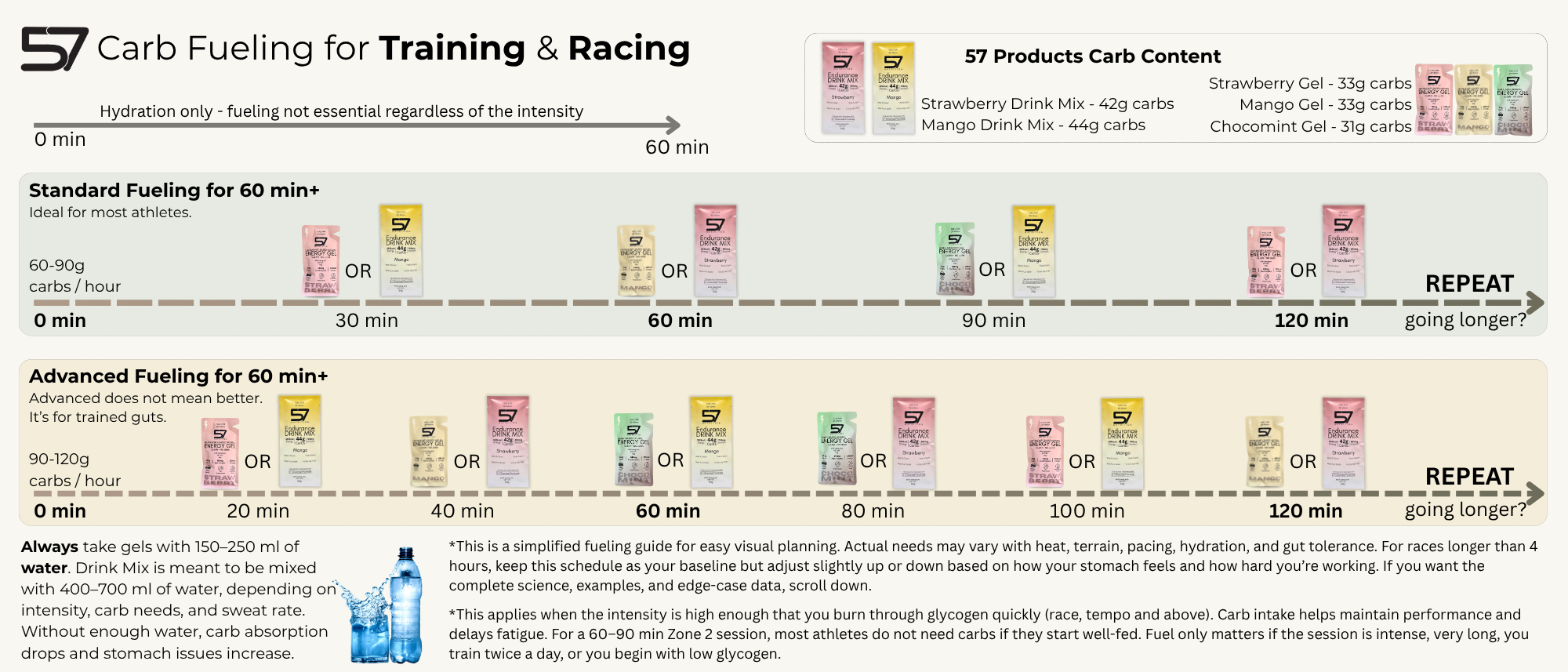
Endurance athletes need somewhere between 30 and 120 grams of carbs per hour, depending on the effort. The numbers aren’t random. They’re based on how much your gut can absorb and how much your muscles burn at different intensities.
The real scientific breakdown
1. Up to 60 minutes: 0–30 g/hr
Purpose: comfort, high-intensity efforts, or taste.
Your stored glycogen can handle this duration unless you’re doing repeated race-level efforts or starting depleted.
Use-case examples:
Short runs
Strength training
Fast intervals <1 hr
Carbs optional, not essential.
2. 1–2 hours: 30–60 g/hr
You’re starting to dip into liver glycogen and working through muscle stores fast enough to justify fueling. This applies when the intensity is high enough that you burn through glycogen quickly (tempo and above). Carb intake helps maintain performance and delays fatigue. For a 60–90 min Zone 2 session, most athletes do not need carbs if they start well-fed. Fuel only matters if the session is long, you train twice a day, or you begin with low glycogen.
Why it matters:
Keeps blood glucose steady
Protects your “high gear”
Reduces post-session fatigue
This is where most athletes underfuel.
3. 2–3+ hours: 60–90 g/hr
You’re deep into glycogen depletion territory. Without external carbs, performance drops fast.
This target is supported by:
Jeukendrup’s multiple transportable carbohydrates research
Dozens of real-world cycling/running studies
WorldTour fueling practices
Ultra and Ironman nutrition protocols
90 g/hr is the gold standard for long endurance.
4. High-intensity long events (pro-level or very well-trained athletes): 90–120 g/hr
You only touch this if:
You’ve trained your gut
You use glucose + fructose blends (dual-carb system – used in all 57 products)
You’re racing near threshold
You’ve tested this in long workouts
120 g/hr is not “hero mode” — it’s science-based, but only works for trained guts.
Most normal athletes should top out at 90 g/hr.
3. How Your Body Absorbs Carbs (And Why Things can Go Wrong)
Your legs don’t decide how much fuel you can use.
Your gut does. And the gut has limits.
Carb absorption isn’t magic. It’s hardware.
Inside your small intestine there are two main transporters:
SGLT1 — absorbs glucose & maltodextrin
Maxes out around 60 g per hour.
This is why “old-school” fueling plans capped at 60.
GLUT5 — absorbs fructose
Adds another 20–60 g per hour, depending on how trained your gut is.
Together, they set the ceiling for 90–120 g/hr. That’s why all 57 products use a glucose + fructose system to hit both transporters and maximize absorption.
Anything above this? Possible in controlled lab settings with elite athletes who’ve spent years practicing it, but not realistic for amateurs or even most semi-pros.
The gut is trainable (to some extenT)
If you normally take 40 g/h and suddenly jump to 90 g/h on race day, your gut will riot.
Regular fueling during training:
Increases transporter numbers
Speeds up stomach emptying
Reduces bloating, cramps, nausea
In short: you earn the right to take more carbs.
Osmolality: the silent killer of comfort
Think of your stomach as a gatekeeper.
If your drink or gel mix is concentrated (and most are; concentrated energy is their purpose):
Fluid gets pulled into the gut instead of into your blood
Stomach emptying slows
You get sloshing, cramps, or that “brick in the stomach” feeling
High-carb + low-water = traffic jam.
This is why water volume matters and why gels + no water is a bad idea. Gels absolutely MUST go together with water.
Intensity makes absorption harder
Once you pass threshold:
Blood flow is redirected from the gut to working muscles
Stomach emptying slows
Nausea risk jumps
The heat generated during intensity compounds the issue
This is why even solid plans fall apart on steep climbs and hot days.
If possible, try to get your carbs during less intense periods of the session.
Dehydration destroys absorption
Losing just 2% of body weight in fluid:
Reduces gastric emptying
Slows intestinal transport
Increases GI distress
Increases perceived effort
You literally can’t absorb carbs properly when dehydrated.
Fuel without fluids is like pumping gas into a clogged hose.
The practical takeaway
- You can only absorb carbs as fast as your gut can transport them.
- You have two transporters. Train them if you want high-carb fueling.
- Too concentrated(lack of water) = stomach slows down.
- Smash the gel right before you hit the aid station so that you can wash it down with ~200ml of water.
- High intensity and heat make digestion worse.
- Dehydration wrecks the entire system.
This is the bridge between “how much you need” and “how much you can actually absorb.”
4. ACTUAL RACE-DAY APPLICATION
Carb Loading – the true fueling
There is a limited amount of fuel you can absorb during an intense effort such as racing. Therefore, pre-fueling smartly is perhaps even more important than the actual gel intake on the race day. 8-10g carbs per kilogram of bodyweight is a good range the day before your event. If you do an exceptionally long one, you might extend this to 2 or 3 days loading. Keep fat and fiber moderate so your gut doesn’t riot.
Race-day breakfast
This is your final carb top-up. Simple rule: 1–3 g/kg carbs, low fiber, low fat, easy-to-digest. If it’s early morning and you normally don’t eat early, train your gut for this ahead of time. Even a small carb snack helps.
Start topping-up early
If you wait until you feel flat, the hole is already dug. First gel should usually go down around 20–30 minutes in. Even earlier on trail if the start is slow and controlled. Then keep repeating every 20-30 minutes – depending on how well trained you are.
Stomach hates surprises
Ever heard the phrase “nothing new on the race day“? This applies to shoes, clothing, and most importantly, nutrition. Never tried 57 gel in training? Then don’t experiment with it during racing. Even the best-researched product on Earth can upset your stomach at 160 bpm+. Always practice your race-day strategy beforehand, ideally multiple times.
Hydration is part of fueling
As we discussed above several times, never underestimate hydration. Water is 50% of the success. Carbs without water move like traffic in Saigon at 5pm. Match carb intake with enough fluid and sodium so absorption stays optimal.
And lastly but importantly, don’t overthink it. Prepare well and trust yourself. Fuel smart, race well.
© 2025 57 Nutrition